"Website maintenance" gets used as a catch-all term, but a five-page brochure site and a login-based web application break in completely different ways — and need completely different kinds of upkeep. If you've been quoted for "website maintenance" when what you actually run is a web application with user accounts, dashboards, or backend logic, you may be paying for the wrong service entirely.
This guide breaks down what separates web application maintenance services from standard website maintenance, so you know exactly what to ask for from a website maintenance service provider — or when you need something more specialized.
What Counts as a "Website" vs a "Web Application"?
Before comparing maintenance needs, it helps to draw the line between the two:
- Website — primarily informational: home page, about page, services, contact forms, a blog. The content does change occasionally, and there is very little logic to the backend that is user specific.
- Web application — interactive and logic-driven: user logins, dashboards, real-time data, payment processing, custom workflows, etc. Consider a bookings system, an internal CRM or a customer portal, instead of just pages, it's software in a browser.
Many sites are actually a hybrid — a marketing website with a login portal bolted on — which is exactly where maintenance plans get mismatched.
Website Maintenance: What It Typically Covers
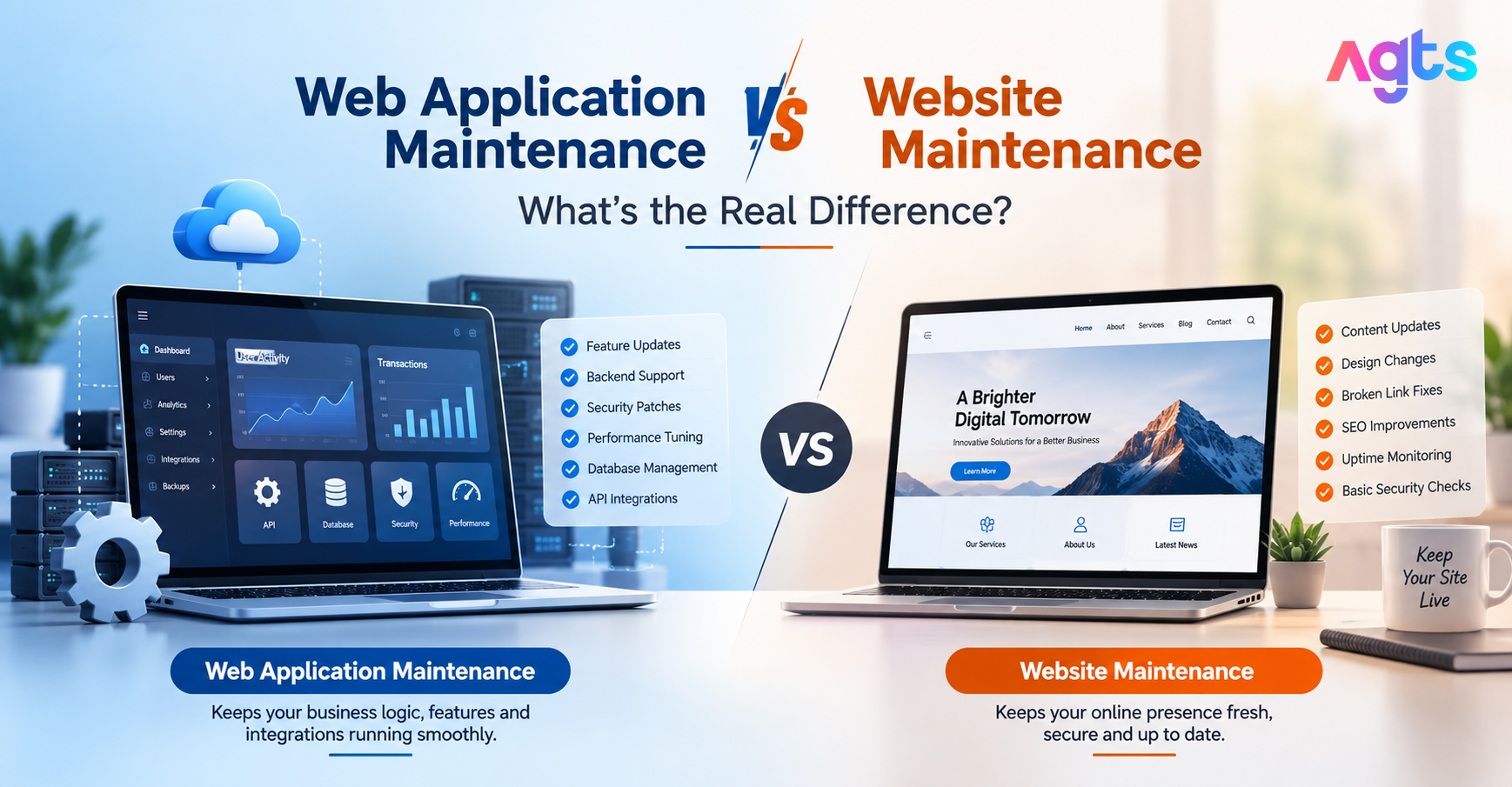
A standard website maintenance service provider focuses on keeping content-driven pages secure, current, and fast:
- CMS core and plugin/theme updates
- Content edits (text, images, new pages)
- Broken link and 404 monitoring
- SSL certificate renewal tracking
- Basic uptime monitoring
- Regular backups
- On page SEO housekeeping (Meta tags, Alt text, Updates of Sitemaps)
This is essentially front end/content based work. It assumes no complex backend logic exists on the site that needs to be tested after each update.
Web Application Maintenance: What It Actually Requires
Web application maintenance services go well beyond content and CMS updates, because there's software logic underneath that content sits on top of:
- Database maintenance — optimizing queries, managing schema changes, monitoring for data integrity issues
- API and integration monitoring — payment gateways, third-party services, and internal APIs need to keep working as dependencies update
- Server-side performance tuning — application response times, load balancing, and caching strategies
- Bug fixes and functional testing — not just "does the page load" but "does the checkout flow, the login, the dashboard calculation still work correctly"
- Security patching at the code level — vulnerabilities in custom-built logic, not just CMS plugins
- User session and authentication management — login systems, password resets, and access control need ongoing attention
- Scalability planning — as user load grows, the application needs monitoring and adjustment that a static website never requires
This is closer to software maintenance than website upkeep — because a web application is, functionally, a piece of software.
Website Maintenance vs Web Application Maintenance: Side-by-Side
|
Aspect |
Website Maintenance |
Web Application Maintenance Services |
|
Primary focus |
Content, CMS, front-end updates |
Backend logic, database, application performance |
|
Typical fixes |
Broken links, plugin updates, content edits |
Bug fixes, API failures, session/auth issues |
|
Security scope |
CMS/plugin vulnerabilities, SSL |
Code-level vulnerabilities, data security, access control |
|
Testing needs |
Visual/front-end checks |
Functional testing across user flows |
|
Skill level required |
Content management, basic dev |
Full-stack development, database administration |
|
Typical cost range (India) |
₹2,000 – ₹15,000/month |
₹15,000 – ₹50,000+/month depending on complexity |
How to Tell Which One You Actually Need
Ask these questions about your site:
- Does it have user accounts or login functionality? → You likely need application-level maintenance.
- Does it process payments or handle sensitive user data? → Application-level security and monitoring, not just website maintenance.
- Is content the main thing that changes, with no custom backend logic? → Standard website maintenance covers this.
- Do you have custom-built features (booking systems, dashboards, calculators)? → That's application logic requiring specialized maintenance.
- Would a broken feature (not just broken content) directly cost you revenue or leads? → You need a maintenance plan built for software, not just pages.
Why Hiring the Wrong Type of Maintenance Provider Backfires
A website maintenance service provider skilled at CMS updates and content edits may not have the full-stack development expertise to debug a failing API integration or optimize a slow database query. Conversely, a team built for complex application-level work may be overkill — and overpriced — for a five-page informational site that only needs occasional content updates and security patching.
Matching the maintenance service to what your site actually is — content-driven or application-driven — is what determines whether you're paying for the right coverage or paying twice: once for a mismatched plan, and again when something breaks that plan was never built to catch.
Getting the Right Coverage for What You Actually Run
The real difference between website maintenance and application-level upkeep isn't the price tag — it's what each is actually built to catch. A content-focused plan protects your pages. An application-focused plan protects the software your business runs on.
AlphaGenix Technology Solutions (AGTS) offers both distinct, correctly scoped plans — so you're not paying for content-only coverage when your site runs backend logic, or paying application-level rates for a site that doesn't need the m. If you're unsure which category your site falls into, talk to AGTS about web application maintenance services built around what your application actually needs.
Frequently Asked Questions
Is web application maintenance more expensive than website maintenance? Generally yes. Full-stack development skills, database management, and API monitoring cost more than the content-focused work standard website maintenance covers.
Can one provider handle both website and web application maintenance? Some agencies offer both, but it's worth confirming they have dedicated backend/full-stack expertise for the application side — not just a content team stretched to cover technical work.
My site has both static pages and a login portal — which plan do I need? Hybrid sites usually need a web application maintenance plan, since the application component (login, data handling) carries the higher security and functional risk, even if most pages are static.
How do I know if my "website" is actually a web application?
If it has user accounts, processes transactions, stores user data, or runs custom logic beyond displaying content, it functions as a web application regardless of how it's described.
What happens if I use a basic website maintenance service provider for a web application?
Critical issues — broken checkout flows, failed API integrations, database performance problems — may go undetected or unresolved, since standard website maintenance isn't scoped to catch backend or application-level failures.