
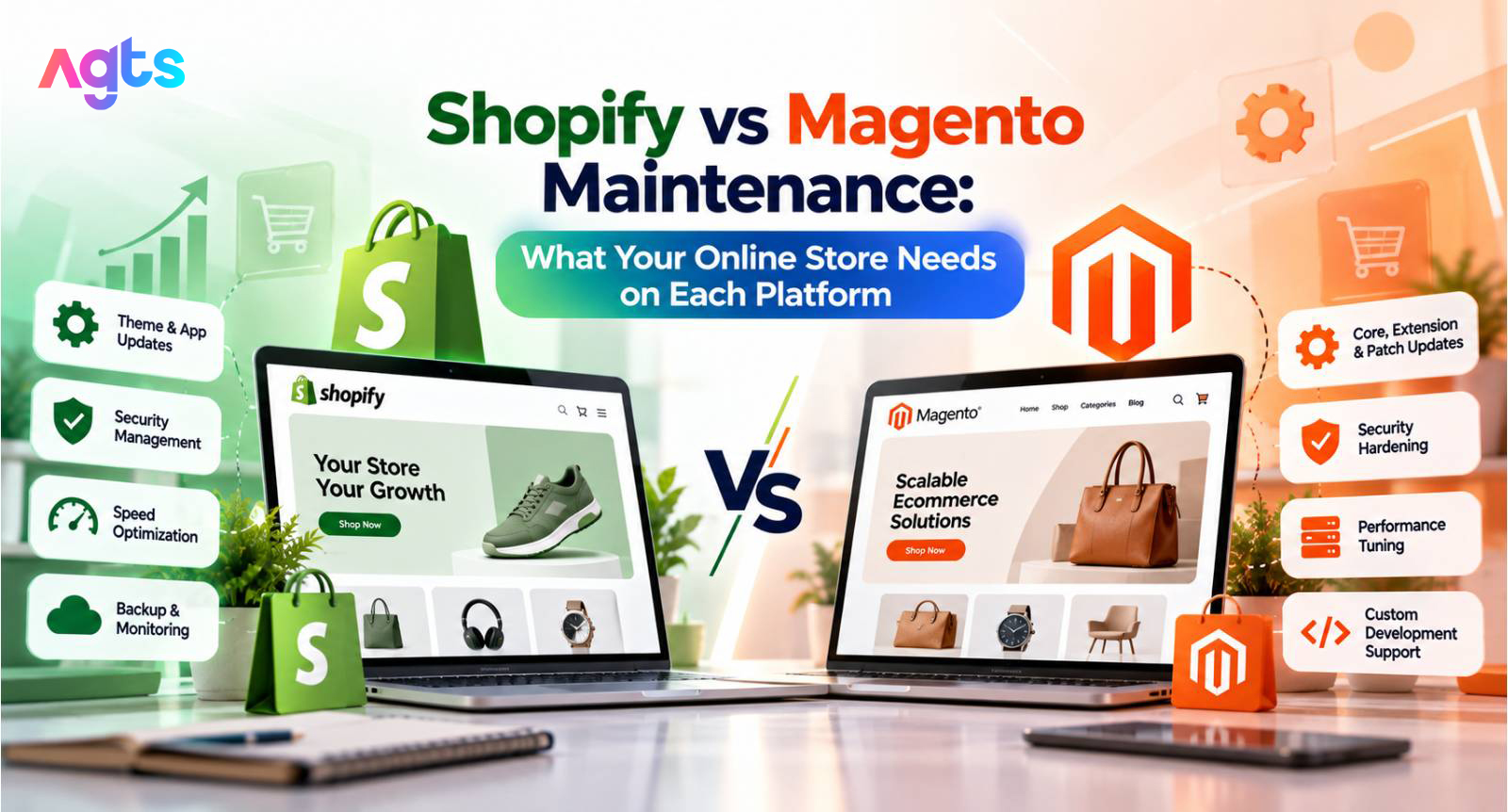
Your online store is always on. Customers are shopping at midnight, checking out on their cell phone, and want everything to load in seconds. Maintaining that experience is continuous work and the kind of work that's distinct between Shopify and Magento.
From the following guide, you'll get an idea of what each platform requires, and when to bring in an e-commerce maintenance team.
Why the Platform Changes Everything
Shopify runs your store on its own servers. It manages to manage your hosting, security and core updates for you. Magento is installed on your own server. It's more freedom, but it's also all of the updates, patches and fixes.
To sum it up: Shopify maintenance is about your theme, apps and store data. Magento maintenance covers everything from the server up.
What Shopify Website Maintenance Involves
Shopify takes care of the platform, but your store still needs regular attention. Good Shopify website maintenance covers:
- App checks: Remove apps you no longer use and update the ones you keep. Every extra app adds scripts that slow your store down.
- Theme updates: Make sure to update your theme and ensure that any custom code is compatible with the new version.
- Speed: Optimise images, cut scripts, and make product pages light.
- Check out and payment : Test checkout, payment gateways and shipping rules monthly.
- Product data: Repair duplicate product links, out of stock product pages and missing product SEO titles.
It seems like every task is small. But, after a few months, you begin to notice your store isn't quite the same place, customers are not as plentiful, and you are still wondering what happened.
What Magento Website Maintenance Involves
With Magento, you have complete management and accountability. Some of the magento website maintenance tasks are:
- Regular patches: Adobe patches it on a regular basis. Quickly apply them, since attackers are after unpatched stores.
- Version upgrades: Make sure to plan upgrades and test your extensions before implementation.
- Care for servers: Caching, Database size, PHP versions, Uptime monitoring and hosting.
- Extensions: Update third party extensions and uninstall any that are conflicting.
- Backup: Make sure you back up your website every day and keep backups away from your server.
- Performance: Tune caching, indexing and search for large catalogues to ensure they remain quick.
Magento is a good option for an enterprise with a large catalog, B2B and multiple store solution. It requires the expertise of a developer that has a deep understanding of the platform.
Shopify vs Magento Maintenance at a Glance
|
Task |
Shopify |
Magento |
|
Hosting and server |
Shopify handles it |
You manage it |
|
Security patches |
Applied automatically |
You apply them |
|
Core updates |
Automatic |
Planned and tested upgrades |
|
Apps / extensions |
Review and update apps |
Update extensions, fix conflicts |
|
Backups |
Needs a backup app |
Daily server backups |
|
Speed work |
Theme, images, apps |
Server, caching, indexing, code |
|
Skills needed |
Shopify specialist |
Experienced Magento developer |
|
Effort |
Low to medium |
Medium to high |
Which Platform Needs More Care?
Magento, by a clear margin. A Shopify store needs a few focused hours each month. A Magento store needs ongoing technical care, especially for security. Neither platform is better for everyone. Pick your maintenance partner based on the platform you run, not the lowest quote.
Signs Your Store Needs Help Now
- Pages load slower than they used to.
- Checkout errors or abandoned carts suddenly rise.
- Apps or extensions clash after an update.
- Your Magento admin shows pending security patches.
- Nobody knows when the last backup ran.
Keep Your Store Running with AGTS
AGTS maintains Shopify and Magento stores for growing brands. We handle updates, security, speed, checkout testing and backups, and send you a clear monthly report. Whether you need Shopify website maintenance or full Magento website maintenance, we start with a free store health check.
Frequently Asked Questions
- Is a Shopify store in need of maintenance?
Yes. While Shopify handles hosting and security, there are still steps to review apps, update your theme, test checkout and ensure your product data is clean. Shopify website maintenance helps to ensure that your store remains fast and selling.
- Does Magento website maintenance guarantee a website's stability?
Features security patch, version updates, server monitoring, extension updates, daily backups and performance tuning. All this is on you, Magento runs on a server of your own.
- Which is easier to maintain, Shopify or Magento?
Shopify. It takes care of the hosting, security and main updates of your site. You're responsible for the server and all updates and Magento requires continuous developer support.
- Is there a lot of work involved in maintaining the website?
Check speed, checkout and apps every month. Magento stores also require security patching for newly released security issues, and daily data backup.
- Is it possible to have an AGTS for Shopify and Magento?
Yes. AGTS maintains Shopify and Magento stores and begins with a free store health check to suggest the proper plan.